
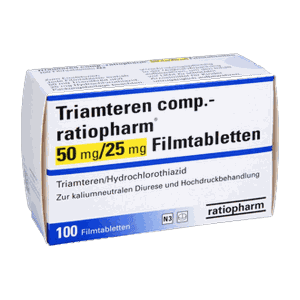
What is Triamterene?
Triamterene is a potassium-sparing diuretic that blocks the sodium channel in the collecting duct of the kidney. It is used almost exclusively in combination with hydrochlorothiazide (HCT) as Triamteren comp. to offset the potassium loss caused by HCT.
As a single-ingredient product, triamterene has only a weak diuretic effect. Its main purpose is to spare potassium. The triamterene/HCT combination is a classic combination diuretic in the treatment of high blood pressure.
Triamteren comp. is taken once daily and usually contains 50 mg triamterene and 25 mg hydrochlorothiazide.
Active Ingredients & Mechanism of Action
Active ingredient: Triamteren
Triamterene blocks epithelial sodium channels (ENaC) in the collecting duct:
Mechanism of action:
- Blocks the epithelial sodium channel (ENaC) in the distal nephron
- Inhibits sodium reabsorption in the collecting duct
- Reduces potassium secretion (potassium-sparing)
- Mild diuretic effect
Difference from spironolactone:
- Acts independently of aldosterone (direct channel blockade)
- Faster onset of action (2-4 hours)
- No antiandrogenic effect
- No gynecomastia
In combination with HCT:
- HCT lowers blood pressure through sodium excretion
- HCT causes potassium loss
- Triamterene offsets the potassium loss
- Synergistic blood-pressure-lowering effect
Onset of action: After 2-4 hours. Maximum effect after 6-8 hours. Duration of action: The potassium-sparing effect of triamterene lasts up to 24 hours, the diuretic effect of HCT 6-12 hours depending on the dose.
Who is it suitable for?
Triamterene (comp.) is suitable for:
- Adults with high blood pressure (as a combination with HCT)
- Edema where preserving potassium is important
- Hypokalemia during treatment with thiazide or loop diuretics
Particularly suitable for:
- Patients with potassium loss on HCT alone
- High blood pressure that requires a diuretic component
- Long-term therapy with diuretics
Not suitable:
- Severe renal impairment (GFR below 30 ml/min)
- Severe hyperkalemia
- Addison's disease
- At the same time as other potassium-sparing diuretics
- Severe liver dysfunction
- Anuria
Available Dosages
Triamteren comp. (triamterene/HCT):
- Usual dose: 1 tablet (50/25 mg) once daily
- Maximum dose: 2 tablets daily
- Take in the morning
Triamterene as a single-ingredient product (rare):
- 50-100 mg once or twice daily
- Maximum dose: 300 mg daily
Available strengths (combination):
- 50 mg triamterene + 25 mg HCT (Triamteren comp.)
Dosage form and pack sizes
The medicines catalogue lists one pack variant: one strength in one pack size.
- Dosage form
- Filmtablette
- Strengths
- 50/25 mg
- Pack sizes
- 100 units
| Strength | Pack | PZN | Duration |
|---|---|---|---|
| 50/25 mg | 100 units | 02581952 | 100 days |
Packs listed in the German medicines catalogue. Which of them are currently available and what they cost is shown in the price overview.
The Pharmazentralnummer (PZN) is the nationwide unique identifier of a pack in Germany.
Duration is the catalogue value for the usual dosage. How long a pack actually lasts depends on the dose your doctor prescribes.
How to Take
How to take:
- Once daily in the morning (after breakfast)
- With sufficient water
- With or after a meal
Important notes:
- Regular monitoring of potassium levels and kidney function
- Do not take additional potassium
- No potassium-containing salt substitutes
- Drink enough fluids
- In case of diarrhea or vomiting: contact a doctor
- Use sun protection (the HCT component can cause photosensitivity)
Special feature: Triamterene can turn the urine a fluorescent blue – this is harmless.
Contraindications
Triamterene (comp.) must not be taken in case of:
- Severe renal impairment (GFR below 30 ml/min)
- Anuria
- Severe hyperkalemia (above 5.5 mmol/l)
- Addison's disease
- Severe hepatic impairment
- At the same time as other potassium-sparing diuretics or potassium supplements
- Hypersensitivity to triamterene, HCT or sulfonamides
Caution in case of:
- Moderate renal impairment
- Diabetes mellitus (hyperkalemia and rise in blood sugar)
- Gout (HCT raises uric acid)
- Kidney stones (triamterene can crystallize)
- Concomitant ACE inhibitors/sartans (hyperkalemia)
- Folic acid deficiency (triamterene is a weak folic acid antagonist)
Pregnancy: Contraindicated. Diuretics can reduce placental perfusion.
Possible Side Effects
Uncommon (0.1-1%):
- Hyperkalemia (due to triamterene)
- Hypokalemia (due to HCT) – usually offset
- Gastrointestinal complaints
- Dry mouth
- Dizziness
- Headache
Rare:
- Kidney stone formation (triamterene crystals)
- Fluorescent blue discoloration of the urine (harmless)
- Rise in uric acid (due to HCT)
- Changes in blood count
- Megaloblastic anemia (folic acid antagonism)
Due to the HCT component:
- Electrolyte disturbances
- Increased blood lipids
- Increased blood sugar
- Photosensitivity (increased sensitivity to light)
- Possible increased risk of skin cancer with long-term use (non-melanoma)
Note: The combination of triamterene and HCT largely offsets the opposing effects of the two active ingredients on potassium. Regular laboratory checks are nevertheless important.
Interactions
Dangerous combinations:
- Potassium supplements → severe hyperkalemia
- Other potassium-sparing diuretics (spironolactone, amiloride) → hyperkalemia
- ACE inhibitors/sartans → increased hyperkalemia (monitor closely)
Caution with:
- Lithium → increased lithium levels (due to HCT)
- NSAIDs → reduced diuretic effect, hyperkalemia
- Antidiabetic drugs → reduced blood-sugar-lowering effect (due to HCT)
- Indomethacin → worsening of kidney function
Note: The combination with ACE inhibitors or sartans is possible but requires close potassium monitoring, as all three substance classes can raise potassium.
Frequently Asked Questions
Triamterene alone has only a weak blood-pressure-lowering effect. Its main purpose is to spare potassium. In combination with HCT, triamterene offsets the potassium loss caused by HCT, while HCT does the main work of lowering blood pressure. A win-win combination.
Triamterene and its metabolite fluoresce blue. This can give the urine a slightly bluish or bluish-green tint. This is completely harmless and no cause for concern. The discoloration disappears after the medication is stopped.
Yes, but with caution. Both triamterene and ACE inhibitors raise potassium levels. In combination, the risk of hyperkalemia is increased. Regular potassium checks are therefore important. Your doctor will monitor the combination.
Similar Medications
Is Triamterene right for you?
A licensed doctor will review your information and issue a prescription if suitable. Discreet and secure.
Important Notice
This information does not replace medical advice. If you have questions about your health or the suitability of this medication, please consult a doctor or pharmacist.
Important Safety Information
This service operates under German pharmaceutical law (HWG). For risks and side effects, read the package leaflet and consult your doctor or pharmacist. All medications are dispensed from a licensed pharmacy in Germany.