
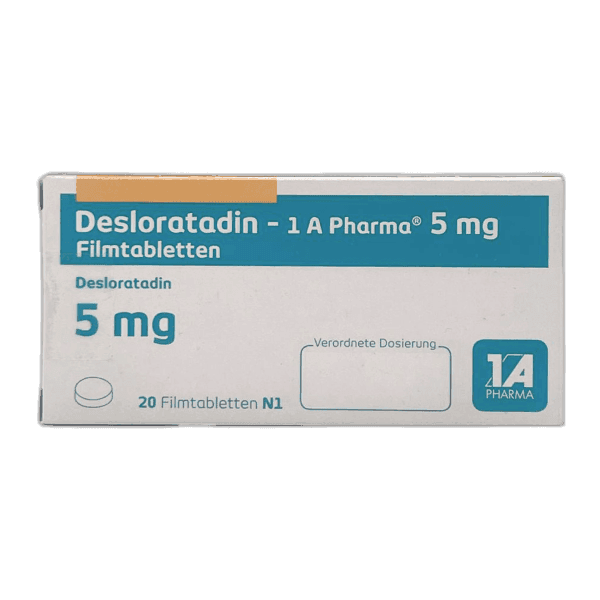
What is Desloratadine?
Desloratadine is a third-generation antihistamine and the active metabolite of loratadine. It is used to treat allergic rhinitis (hay fever), allergic rhinoconjunctivitis, and chronic urticaria (hives).
The active ingredient selectively blocks H1 histamine receptors and thus acts specifically against typical allergy symptoms such as sneezing, runny nose, itching, and watery eyes. Desloratadine is available under the brand name Aerius® and as a generic from numerous manufacturers (e.g., Desloratadin-ratiopharm®, Desloratadin HEXAL®).
Unlike older antihistamines such as cetirizine or diphenhydramine, desloratadine barely crosses the blood-brain barrier and therefore usually does not cause drowsiness.
Active Ingredients & Mechanism of Action
Active ingredient: Desloratadin
Desloratadine acts specifically on the allergic reaction:
Mechanism of action:
- Selective blockade of peripheral H1 histamine receptors
- Prevents histamine from exerting its allergic effects
- Additional anti-inflammatory properties (inhibits interleukin-4, interleukin-13, and other mediators)
- Inhibited the release of inflammatory substances from mast cells in laboratory studies (clinical relevance not yet confirmed)
Advantages over older antihistamines:
- No relevant sedation (does not make you sleepy)
- No impairment of driving ability at the recommended dose
- No interaction with grapefruit juice or CYP3A4 inhibitors
Onset of action: The effect begins within 1 hour. Maximum plasma concentration is reached after about 3 hours. The duration of action is 24 hours, so taking it once daily is sufficient.
Who is it suitable for?
Desloratadine is suitable for:
- Adults and adolescents aged 12 years and older with allergic rhinitis (hay fever)
- Patients with chronic idiopathic urticaria (hives)
- Year-round or seasonal allergy symptoms
- House dust allergy with a constantly runny nose
Especially recommended for:
- Patients who need to stay fully functional during the day (work, driving)
- When loratadine is not effective enough
- When a non-sedating antihistamine is needed
- Combination with nasal corticosteroids for severe symptoms
Not suitable for:
- Children under 1 year of age (as a solution from 1 year, tablets from 12 years)
- Hypersensitivity to desloratadine or loratadine
Available Dosages
Adults and adolescents aged 12 years and older:
- 5 mg once daily (one film-coated tablet)
- Take with or without food
Children (as syrup/solution, prescribed by a doctor):
- 1–5 years: 1.25 mg once daily
- 6–11 years: 2.5 mg once daily
Available dosage forms:
- 5 mg film-coated tablets
- 5 mg orodispersible tablets (Aerius® orodispersible tablets)
- 0.5 mg/ml oral solution (for children)
Duration of use:
- Seasonal: during the pollen season
- Year-round: for perennial rhinitis or chronic urticaria, as recommended by a doctor
Dosage form and pack sizes
The medicines catalogue lists one pack variant: one strength in one pack size.
- Dosage form
- Filmtablette
- Strengths
- 5 mg
- Pack sizes
- 100 units
| Strength | Pack | PZN | Duration |
|---|---|---|---|
| 5 mg | 100 units | 15785917 | 100 days |
Packs listed in the German medicines catalogue. Which of them are currently available and what they cost is shown in the price overview.
The Pharmazentralnummer (PZN) is the nationwide unique identifier of a pack in Germany.
Duration is the catalogue value for the usual dosage. How long a pack actually lasts depends on the dose your doctor prescribes.
How to Take
How to take:
- Once daily, always at the same time of day
- With or without food
- Swallow the film-coated tablet with water
- Place the orodispersible tablet on the tongue; it dissolves without water
Important information:
- Take regularly for optimal effect during the pollen season
- Can also be taken as needed (intermittently)
- In severe kidney impairment, use only with caution
- If you miss a dose: take the next dose at the usual time, do not take a double dose
Tips for hay fever:
- Additionally, a nasal corticosteroid for a stuffy nose
- Check the pollen calendar and reduce exposure
- Allergen avoidance measures support the treatment
Contraindications
Desloratadine must not be taken in cases of:
- Hypersensitivity to desloratadine or loratadine
- Hypersensitivity to any of the other ingredients
Caution in cases of:
- Severe kidney impairment
- History of epilepsy (the seizure threshold may be lowered)
- Concurrent use of medications that lower the seizure threshold
Pregnancy and breastfeeding: Use during pregnancy should only take place after a strict benefit-risk assessment. Desloratadine passes into breast milk. During breastfeeding, it should only be taken after consulting a doctor.
Possible Side Effects
Common (1–10%):
- Headache
- Dry mouth
- Fatigue (much less common than with older antihistamines)
Very rare (< 0.01%):
- Dizziness
- Sleep disorders
- Gastrointestinal complaints
- Tachycardia (racing heart)
- Myalgia (muscle pain)
- Hypersensitivity reactions
- Elevated liver enzymes
- Anaphylaxis (extremely rare)
General: Desloratadine is considered very well tolerated. In clinical studies, the rate of side effects was barely higher than with placebo. The sedation rate is below 2% and is therefore significantly lower than with cetirizine.
Interactions
Clinically relevant interactions: Desloratadine has a very favorable interaction profile. It is not significantly metabolized by CYP enzymes.
No relevant interaction with:
- Grapefruit juice
- Ketoconazole, erythromycin (no QT prolongation)
- Alcohol (no increase in sedation in studies, but caution is still advised)
- Food
Caution with:
- Other medications with a sedative effect (although desloratadine itself causes hardly any sedation)
- Medications that prolong the QT interval (theoretical risk)
Note: Desloratadine has one of the most favorable interaction profiles of all antihistamines.
Frequently Asked Questions
Desloratadine is the active metabolite of loratadine. It works more strongly and more quickly because it does not first have to be activated in the liver. Desloratadine also has additional anti-inflammatory properties and an even more favorable side effect profile than loratadine.
Desloratadine is one of the non-sedating antihistamines. In studies, fatigue (1.2%) was among the most common side effects reported more often than with placebo. Drowsiness did not occur more often than with placebo at 5 mg daily in controlled studies.
Yes, desloratadine can be combined very well with nasal corticosteroids (e.g., mometasone, fluticasone). For moderate to severe hay fever, this combination is often more effective than either active ingredient alone.
Yes, at the recommended dose of 5 mg, desloratadine does not impair driving ability. It was tested in driving simulator studies and showed no impairment. Nevertheless, you should pay attention to your individual reaction.
Similar Medications
Is Desloratadine right for you?
A licensed doctor will review your information and issue a prescription if suitable. Discreet and secure.
Important Notice
This information does not replace medical advice. If you have questions about your health or the suitability of this medication, please consult a doctor or pharmacist.
Important Safety Information
This service operates under German pharmaceutical law (HWG). For risks and side effects, read the package leaflet and consult your doctor or pharmacist. All medications are dispensed from a licensed pharmacy in Germany.