
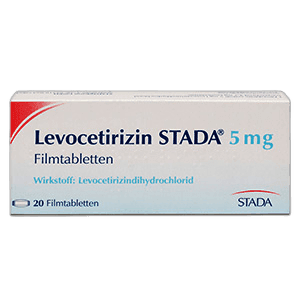
What is Levocetirizine?
Levocetirizine is the active enantiomer (levorotatory form) of cetirizine and belongs to the second generation of antihistamines. It is used for allergic rhinitis (hay fever), perennial rhinitis, and chronic idiopathic urticaria.
At a dose of only 5 mg, levocetirizine achieves the same efficacy as 10 mg of cetirizine, but with a side effect profile that tends to be more favorable. Levocetirizine is available as a generic (e.g., Levocetirizin-ratiopharm®, Levocetirizin HEXAL®) and under the brand name Xusal®.
It acts very quickly.
Active Ingredients & Mechanism of Action
Active ingredient: Levocetirizindihydrochlorid
Levocetirizine selectively blocks H1 histamine receptors:
Mechanism of action:
- High-affinity blockade of peripheral H1 receptors
- Twice the receptor affinity compared with cetirizine
- Inhibits histamine-mediated vasodilation, edema formation, and itching
- Additional anti-inflammatory properties
Pharmacokinetics:
- Rapid absorption: onset of action after 30–60 minutes
- High oral bioavailability (> 85%)
- Half-life: 7–10 hours
- Duration of action: over 24 hours with a single dose
Advantages:
- Fastest onset of action among oral antihistamines
- High efficacy at a low dose
- Less sedation than cetirizine
Who is it suitable for?
Levocetirizine is suitable for:
- Adults and children aged 6 years and older with seasonal allergic rhinitis
- Patients with perennial (year-round) allergic rhinitis
- Chronic idiopathic urticaria
Particularly recommended for:
- Patients who need very rapid symptom relief
- When cetirizine 10 mg causes too much tiredness (levocetirizine 5 mg is often better tolerated)
- Severe allergic symptoms that require a potent antihistamine
Not suitable:
- Children under 2 years of age
- Severe renal insufficiency (creatinine clearance < 10 ml/min)
- Hypersensitivity to levocetirizine, cetirizine, or hydroxyzine
Available Dosages
Adults and adolescents aged 12 years and older:
- 5 mg once daily (one film-coated tablet)
Children:
- 6–11 years: 5 mg once daily
- 2–5 years: 1.25 mg twice daily (as drops)
Available dosage forms:
- 5 mg film-coated tablets
- Oral drops (for children)
Dose adjustment in renal insufficiency:
- Mild (CrCl 50–79): 5 mg daily
- Moderate (CrCl 30–49): 5 mg every 2 days
- Severe (CrCl 10–29): 5 mg every 3 days
- Dialysis: contraindicated
Dosage form and pack sizes
The medicines catalogue lists 2 pack variants: one strength in 2 pack sizes. Pack sizes range from 20 to 100 units.
- Dosage form
- Filmtablette
- Strengths
- 5 mg
- Pack sizes
- 20 units, 100 units
| Strength | Pack | PZN | Duration |
|---|---|---|---|
| 5 mg | 20 units | 15197735 | 20 days |
| 5 mg | 100 units | 14243953 | 100 days |
Packs listed in the German medicines catalogue. Which of them are currently available and what they cost is shown in the price overview.
The Pharmazentralnummer (PZN) is the nationwide unique identifier of a pack in Germany.
Duration is the catalogue value for the usual dosage. How long a pack actually lasts depends on the dose your doctor prescribes.
How to Take
How to take:
- Once daily, preferably in the evening (if mild tiredness occurs)
- Regardless of meals (food slightly delays absorption)
- Swallow the film-coated tablet whole with water, without chewing
- Drops directly into the mouth or on a spoon
Important notes:
- Take regularly for optimal effect
- If tiredness occurs: move intake to the evening
- Alcohol can increase the sedative effect – use caution
- Do not take together with other sedating medications
Duration of use:
- Seasonal allergy: during the pollen season
- Perennial allergy: year-round as recommended by a doctor
- Urticaria: until symptom-free
Contraindications
Levocetirizine must not be taken in cases of:
- Hypersensitivity to levocetirizine, cetirizine, or hydroxyzine
- Severe renal insufficiency (creatinine clearance < 10 ml/min)
- Renal insufficiency requiring dialysis
Caution in cases of:
- Impaired kidney function (dose adjustment required)
- Epilepsy or increased susceptibility to seizures
- Concurrent alcohol consumption
- Predisposition to urinary retention (e.g., spinal cord lesion, prostatic hyperplasia)
Pregnancy and breastfeeding: There are insufficient data on use during pregnancy. It passes into breast milk. During pregnancy and breastfeeding, use only after consulting a doctor.
Possible Side Effects
Common (1–10%):
- Headache
- Drowsiness/tiredness (less than with cetirizine)
- Dry mouth
- Fatigue
Uncommon (0.1–1%):
- Abdominal pain
Frequency not known:
- Nausea
- Dizziness
- Visual disturbances
- Palpitations
- Weight gain
- Hypersensitivity reactions
- Seizures
- Liver function disorders
- Aggression, agitation
Note: Compared with cetirizine 10 mg, the rate of sedation with levocetirizine 5 mg is somewhat lower.
Interactions
Caution when taken at the same time as:
- Alcohol (increased sedation possible)
- Other CNS depressants (benzodiazepines, opioids)
- Theophylline (slight inhibition of levocetirizine clearance)
- Ritonavir (may increase levocetirizine levels)
No relevant interaction with:
- Pseudoephedrine
- Food (slight delay, but no loss of effect)
- Medications dependent on CYP enzymes (minimal CYP metabolism)
Note: Levocetirizine has a relatively favorable interaction profile, as it is hardly metabolized by the liver and is mainly excreted by the kidneys.
Frequently Asked Questions
Levocetirizine is the active enantiomer of cetirizine. 5 mg of levocetirizine achieves the same effect as 10 mg of cetirizine, often with somewhat less tiredness.
Because levocetirizine can cause mild tiredness in some patients, many doctors recommend taking it in the evening. If you do not notice any tiredness, you can also take it in the morning. The effect lasts 24 hours.
Yes, levocetirizine is approved for both seasonal and year-round (perennial) allergic rhinitis. In the case of a house dust allergy, it can be taken year-round, in support of allergen avoidance measures.
Similar Medications
Is Levocetirizine right for you?
A licensed doctor will review your information and issue a prescription if suitable. Discreet and secure.
Important Notice
This information does not replace medical advice. If you have questions about your health or the suitability of this medication, please consult a doctor or pharmacist.
Important Safety Information
This service operates under German pharmaceutical law (HWG). For risks and side effects, read the package leaflet and consult your doctor or pharmacist. All medications are dispensed from a licensed pharmacy in Germany.