
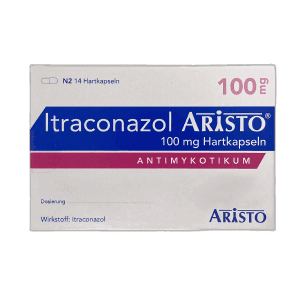
What is Itraconazole?
Itraconazole is a triazole antifungal with a broad spectrum of activity that is used for various fungal infections. In vulvovaginal candidiasis, it is used when fluconazole or clotrimazole is not sufficiently effective, particularly in infections with non-albicans Candida species (e.g., C. glabrata, C. krusei).
Itraconazole is marketed under the brand name Sempera® and as a generic. It is also approved for fungal skin infections, nail fungus, and systemic mycoses.
Active Ingredients & Mechanism of Action
Active ingredient: Itraconazol
Mechanism of action:
- Inhibits 14-alpha-demethylase (CYP51)
- Blocks ergosterol synthesis in the fungal cell membrane
- Ergosterol is an essential component of the fungal cell membrane
- The cell membrane becomes unstable → the fungal cell dies
Broader spectrum than fluconazole:
- Candida albicans and non-albicans species
- Aspergillus
- Dermatophytes
- Also effective against some fluconazole-resistant strains
Pharmacokinetics:
- Lipophilic → good tissue penetration
- Long half-life → the effect persists after discontinuation
- Absorption strongly dependent on stomach acid and food
Who is it suitable for?
Itraconazole is suitable for:
- Vulvovaginal candidiasis that does not respond to fluconazole
- Infections with non-albicans Candida species
- Recurrent candidiasis (suppressive therapy)
- Fungal skin and nail infections
- Systemic mycoses
Not suitable:
- Pregnancy (teratogenic in animal studies)
- Heart failure
- Severe hepatic insufficiency
- Concomitant use of certain medications (CYP3A4 interactions)
Available Dosages
Vulvovaginal candidiasis:
- 200 mg twice daily for 1 day (short-term therapy)
- Or 200 mg once daily for 3 days
Recurrent candidiasis (suppression):
- 200 mg once daily for the first 3 days of menstruation, over a period of 6 months
Available strengths:
- 100 mg capsules
Important:
- Take the capsules with a full meal (absorption!)
- In achlorhydric gastric conditions (proton pump inhibitors): absorption greatly reduced
Dosage form and pack sizes
The medicines catalogue lists 2 pack variants: one strength in 2 pack sizes. Pack sizes range from 15 to 28 units.
- Dosage form
- Hartkapsel
- Strengths
- 100 mg
- Pack sizes
- 15 units, 28 units
| Strength | Pack | PZN | Duration |
|---|---|---|---|
| 100 mg | 15 units | 00772895 | 0 days |
| 100 mg | 28 units | 00236961 | 0 days |
Packs listed in the German medicines catalogue. Which of them are currently available and what they cost is shown in the price overview.
The Pharmazentralnummer (PZN) is the nationwide unique identifier of a pack in Germany.
Duration is the catalogue value for the usual dosage. How long a pack actually lasts depends on the dose your doctor prescribes.
How to Take
How to take:
- Take immediately after a complete meal
- Swallow the capsules whole
- Take with sufficient fluid (1 glass of water)
- In achlorhydria or if you take medicines that reduce stomach acid (e.g. H2 antagonists, proton pump inhibitors): take with a non-diet cola drink
Important notes:
- Absorption is highly dependent on food
- PPIs (omeprazole, etc.) significantly reduce absorption
- Check liver function before and during therapy
- Reliable contraception during therapy and until the first menstrual period after the end of therapy (women)
Contraindications
Itraconazole must not be taken in cases of:
- Hypersensitivity to itraconazole
- Pregnancy
- Heart failure (NYHA III–IV)
- Concomitant use of: terfenadine, astemizole, cisapride, simvastatin, lovastatin, midazolam (oral), triazolam, pimozide, quinidine, dofetilide, ergotamine
Use with caution in:
- Liver disease (hepatotoxic!)
- Impaired kidney function
- Achlorhydria/PPI therapy (reduced absorption)
- QT prolongation
- Breastfeeding (itraconazole passes into breast milk, if in doubt do not breastfeed)
Possible Side Effects
Common (1–10%):
- Nausea, abdominal pain
- Headache
- Elevated liver enzymes
- Skin rash
Uncommon (0.1–1%):
- Diarrhea, constipation
- Dizziness
- Menstrual cycle disorders
- Edema
Rare but serious:
- Hepatotoxicity (ranging from liver inflammation to liver failure)
- Heart failure
- Peripheral neuropathy
- Stevens-Johnson syndrome
Note: For therapy lasting more than 1 month or in the presence of risk factors: regular monitoring of liver function.
Frequently Asked Questions
Itraconazole has a broader spectrum of activity than fluconazole and is also effective against some fluconazole-resistant Candida species (e.g., C. glabrata, C. krusei). It is used when fluconazole is not sufficiently effective or when the culture of the pathogen shows resistance.
Itraconazole capsules need an acidic stomach environment and dietary fats to be absorbed. Without a meal, only a fraction of the active ingredient is absorbed. Patients on PPI therapy should discuss this with their doctor.
Yes, itraconazole can cause birth defects in animal studies and is contraindicated during pregnancy. Women of childbearing age must use reliable contraception during therapy and until the first menstrual period after the end of therapy.
Similar Medications
Is Itraconazole right for you?
A licensed doctor will review your information and issue a prescription if suitable. Discreet and secure.
Important Notice
This information does not replace medical advice. If you have questions about your health or the suitability of this medication, please consult a doctor or pharmacist.
Important Safety Information
This service operates under German pharmaceutical law (HWG). For risks and side effects, read the package leaflet and consult your doctor or pharmacist. All medications are dispensed from a licensed pharmacy in Germany.