
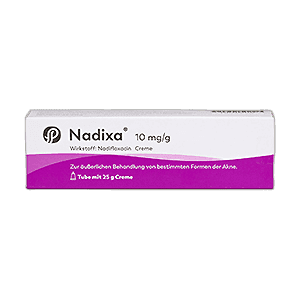
What is Nadixa?
Nadixa is a prescription-only cream containing the active ingredient nadifloxacin, a topical fluoroquinolone antibiotic. It is used to treat inflammatory acne vulgaris.
Nadifloxacin has a bactericidal effect against the acne-causing bacteria Cutibacterium acnes (formerly Propionibacterium acnes) and other skin germs. Unlike erythromycin or clindamycin, nadifloxacin shows less development of resistance.
The cream is applied to the affected areas of skin 2x daily and is approved for adults and adolescents aged 14 years and older.
Active Ingredients & Mechanism of Action
Active ingredient: Nadifloxacin 1%
Nadifloxacin acts as a gyrase inhibitor:
Mechanism of action:
- Inhibits bacterial DNA gyrase (topoisomerase II)
- Prevents DNA replication in bacteria
- Bactericidal effect against Cutibacterium acnes
- Additional effect against Staphylococcus aureus
Advantages:
- Low resistance rate compared with erythromycin/clindamycin
- Broad antibacterial spectrum
- Local application only (low systemic absorption)
Time course:
- First improvement: after 2-4 weeks
- Optimal effect: after 4-8 weeks of regular use
Who is it suitable for?
Nadixa is suitable for:
- Mild to moderate inflammatory acne vulgaris
- Papulopustular acne
- Adults and adolescents aged 14 years and older
Advantages:
- Alternative in cases of resistance to erythromycin/clindamycin
- Less development of resistance
- Well tolerated
Not suitable:
- Severe nodular or cystic acne (systemic therapy required)
- Children under 14 years of age
- Comedones only (non-inflammatory acne)
Available Dosages
Nadixa Cream 1%:
- Apply a thin layer to the affected areas of skin 2x daily
- In the morning and evening after cleansing
- Duration of treatment: usually 4-8 weeks
Note: Do not use for longer than 8 weeks.
How to Take
Application: 1. Cleanse and dry the face thoroughly 2. Apply a thin layer of Nadixa to the inflamed areas 3. Gently massage in 4. Wash your hands 5. 2x daily (morning and evening)
Important:
- Avoid contact with the eyes, mouth, and mucous membranes
- If skin irritation occurs, reduce or pause application
- Use sun protection
Contraindications
Do not use in case of:
- Hypersensitivity to nadifloxacin or other quinolones
- Children under 14 years of age
Caution in case of:
- Sensitive skin
- Simultaneous UV exposure (photosensitization possible)
Pregnancy: Not recommended. Insufficient data.
Breastfeeding: Not recommended.
Possible Side Effects
Common (1-10%):
- Itching
Uncommon:
- Dry skin
- Skin irritation, redness, skin rash
- Burning at the application site, feeling of warmth
- Papules
- Contact dermatitis
- Episodes of skin reddening with a feeling of heat (flushing)
Rare:
- Hives (urticaria)
Interactions
Interactions:
- No clinically relevant interactions are known with topical use
Can be combined with:
- Benzoyl peroxide (applied at different times)
- Retinoids (applied at different times, e.g., retinoid in the evening, Nadixa in the morning)
Frequently Asked Questions
Nadifloxacin has a lower resistance rate than erythromycin and clindamycin. If these antibiotics no longer work sufficiently, Nadixa can be a good alternative.
The duration of treatment is up to 8 weeks. After that, the antibiotic should be stopped or switched to avoid resistance.
Similar Medications
Is Nadixa right for you?
A licensed doctor will review your information and issue a prescription if suitable. Discreet and secure.
Important Notice
This information does not replace medical advice. If you have questions about your health or the suitability of this medication, please consult a doctor or pharmacist.
Important Safety Information
This service operates under German pharmaceutical law (HWG). For risks and side effects, read the package leaflet and consult your doctor or pharmacist. All medications are dispensed from a licensed pharmacy in Germany.