
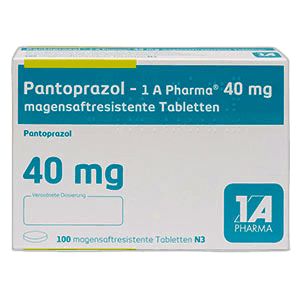
What is Pantoprazole?
Pantoprazole is a proton pump inhibitor (PPI) used to treat acid-related disorders of the stomach and esophagus. It is available under the brand name Pantozol® and as numerous generics.
Pantoprazole has a lower potential for interactions than omeprazole. It affects the enzyme CYP2C19 less strongly and can therefore be combined more easily with other medications – especially with the antiplatelet drug clopidogrel.
Active Ingredients & Mechanism of Action
Active ingredient: Pantoprazol
Pantoprazole irreversibly inhibits the proton pump in the parietal cells:
Mechanism of action:
- Prodrug that is activated in the acidic environment of the parietal cell
- Covalent binding to H+/K+-ATPase
- Blocks gastric acid secretion at the final step
- Acid reduction of up to 90%
Pharmacokinetics:
- Bioavailability approx. 77% (higher than omeprazole)
- Full effect after 2-3 days of regular use
- Low potential for CYP interactions
Compared with omeprazole: Pantoprazole has a lower affinity for CYP2C19 and CYP3A4, which leads to fewer drug interactions.
Who is it suitable for?
Pantoprazole is suitable for:
- Gastroesophageal reflux disease (GERD)
- Reflux esophagitis
- Gastric and duodenal ulcers
- Helicobacter pylori eradication (combination therapy)
- Stomach protection during NSAID/ASA therapy
- Patients taking clopidogrel
- Zollinger-Ellison syndrome
Particularly suitable for:
- Patients taking many concomitant medications (lower risk of interactions)
Available Dosages
Available strengths:
- 20 mg (over the counter / prescription-only)
- 40 mg (prescription-only)
Usual dosages:
- Heartburn/mild reflux: 20 mg 1x daily
- Reflux esophagitis: 40 mg 1x daily for 4-8 weeks
- Stomach protection with NSAIDs: 20 mg 1x daily
- Helicobacter eradication: 40 mg 2x daily (with antibiotics)
- Maintenance therapy: 20 mg 1x daily
Dosage form and pack sizes
The medicines catalogue lists 2 pack variants: 2 strengths in one pack size.
- Dosage form
- Magensaftresistente Tablette
- Strengths
- 20 mg, 40 mg
- Pack sizes
- 30 units
| Strength | Pack | PZN | Duration |
|---|---|---|---|
| 20 mg | 30 units | 00294645 | 30 days |
| 40 mg | 30 units | 05046981 | 30 days |
Packs listed in the German medicines catalogue. Which of them are currently available and what they cost is shown in the price overview.
The Pharmazentralnummer (PZN) is the nationwide unique identifier of a pack in Germany.
Duration is the catalogue value for the usual dosage. How long a pack actually lasts depends on the dose your doctor prescribes.
How to Take
How to take:
- In the morning, 30 minutes before breakfast
- Swallow the tablet whole, without chewing, with water
- Do not split gastro-resistant tablets
Long-term therapy:
- Regular medical check-ups
- Aim for the lowest effective dose
- When tapering off: reduce the dose gradually over 2-4 weeks
Notes:
- Can also be given intravenously (hospital)
- In severe liver insufficiency: max. 20 mg daily
Contraindications
Pantoprazole must not be taken in case of:
- Hypersensitivity to pantoprazole or other PPIs
Caution in case of:
- Concomitant use of atazanavir (HIV medication, not recommended)
- Severe liver insufficiency (max. 20 mg, monitor liver function tests)
- Long-term use (same risks as with other PPIs)
- Suspected stomach cancer (symptoms may be masked)
Pregnancy/breastfeeding: Limited data. Use only if clearly indicated.
Possible Side Effects
Common (1-10%):
- Benign glandular polyps of the gastric fundus
Uncommon:
- Headache
- Abdominal pain
- Diarrhea
- Constipation
- Flatulence
- Nausea, vomiting
- Dizziness
- Sleep disorders
Rare:
- Joint pain
With long-term use:
- Magnesium deficiency (muscle cramps, cardiac arrhythmias)
- Increased risk of fractures
- Vitamin B12 deficiency
- Possible risk of Clostridium difficile infections
Note: Side effect profile comparable to other PPIs. Long-term risks affect all proton pump inhibitors equally.
Interactions
Low potential for interactions
Reduced absorption due to increased pH:
- Ketoconazole, itraconazole
- Iron supplements
- Erlotinib
No relevant interaction with:
- Clopidogrel
- Metoprolol
- Nifedipine
- Diazepam
Not recommended with:
- Atazanavir (HIV protease inhibitor) – loss of efficacy
Frequently Asked Questions
Pantoprazole has a lower potential for interactions. This is particularly important for patients taking clopidogrel (a blood thinner). Omeprazole can weaken the effect of clopidogrel; pantoprazole does not.
The duration depends on the indication. Short-term (4-8 weeks) for acute symptoms. Long-term for reflux disease or as stomach protection, but only under regular medical supervision and at the lowest effective dose.
After short-term use (< 4 weeks), you can stop abruptly. After longer use, tapering off over 2-4 weeks is advisable to avoid a rebound effect (increased acid production).
Similar Medications
Is Pantoprazole right for you?
A licensed doctor will review your information and issue a prescription if suitable. Discreet and secure.
Important Notice
This information does not replace medical advice. If you have questions about your health or the suitability of this medication, please consult a doctor or pharmacist.
Important Safety Information
This service operates under German pharmaceutical law (HWG). For risks and side effects, read the package leaflet and consult your doctor or pharmacist. All medications are dispensed from a licensed pharmacy in Germany.