
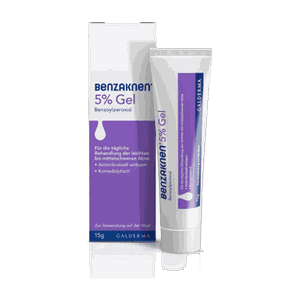
What is Benzoyl peroxide?
Benzoyl peroxide (BPO) is an acne treatment. It is available without a prescription and has been used for decades. The big advantage: there is no development of resistance.
Benzoyl peroxide has an antibacterial effect by releasing oxygen, which kills the anaerobic acne bacteria. In addition, it has a mild peeling (keratolytic) effect.
Available in various concentrations (2.5%, 5%, 10%) and formulations (gel, cream, wash lotion). Well-known brands are Benzaknen®, PanOxyl® and Aknefug BP®.
Active Ingredients & Mechanism of Action
Active ingredient: Benzoylperoxid 2,5-10%
Benzoyl peroxide works by releasing oxygen:
Antibacterial mechanism:
- BPO breaks down on the skin into benzoic acid and oxygen
- The free oxygen oxidizes bacterial proteins
- P. acnes (anaerobic) is killed
- No development of resistance possible!
Keratolytic effect:
- Mild peeling effect
- Dissolves keratin plugs in the pores
- Opens clogged follicles
Why no resistance? The oxidative mechanism is nonspecific – bacteria cannot develop resistance to it. This is why BPO is indispensable for preventing resistance during antibiotic therapy.
Who is it suitable for?
Benzoyl peroxide is suitable for:
- Mild to moderate acne
- All forms of acne with inflammation
- As an add-on to antibiotics (prevents resistance)
- For maintenance therapy
- As an OTC treatment without a prescription
Advantages:
- No development of resistance
- Available without a prescription
- Easy to combine
Limitations:
- Can bleach fabrics
- Irritating for sensitive skin
- Dries out the skin
Available Dosages
Concentrations:
- 2.5% – mild, for sensitive skin
- 5% – standard
- 10% – strong, for robust skin
Important: Higher concentration = more irritation. 10% is intended for severe acne and for acne in which a lower-concentration preparation has not led to treatment success.
Dosage forms:
- Gel (standard)
- Cream (for dry skin)
- Wash lotion (less irritating)
- Spot treatment
Recommendation: Start with 2.5% and increase only if well tolerated.
How to Take
Applying gel/cream: 1. Cleanse the skin and let it dry 2. Apply thinly to the affected areas 3. 1-2x daily (start with 1x daily) 4. Let it absorb
Wash lotion (least irritating): 1. Apply to damp skin 2. Leave on for 1-2 minutes 3. Rinse off thoroughly 4. 1x daily
Getting used to it:
- For sensitive skin 1x daily before going to bed
- Pause in case of severe irritation
Caution:
- Bleaches fabrics (towels, pillowcases, clothing)!
- Use white bed linen and old towels
- Wash your hands after application
Contraindications
Do not use in case of:
- Hypersensitivity to benzoyl peroxide
- On injured or severely irritated skin
- In the area of the eyes and mucous membranes
Caution in case of:
- Very sensitive skin
- Atopic dermatitis
- Rosacea (can make it worse)
- Simultaneous use of other irritating products
Pregnancy and breastfeeding: Can be used. Low systemic absorption.
Possible Side Effects
Common:
- Dry skin
- Redness
- Scaling
- Burning during application
- Itching
Uncommon:
- Allergic contact dermatitis
- Increased sensitivity to sunlight
Frequency not known:
- Allergic reactions, including at the application site, up to anaphylaxis
- Swelling of the face
Initial worsening: In the first few days, the acne may briefly appear worse.
Bleaching of fabrics: Not a side effect, but important: BPO bleaches fabrics irreversibly!
Interactions
Caution when used at the same time as:
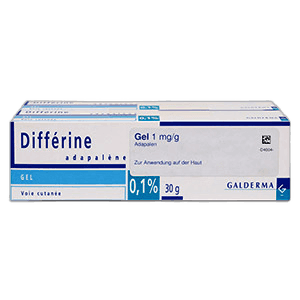
- Retinoids (tretinoin, adapalene) – increased irritation
- Other drying products
- AHA/BHA peels
Useful combination:
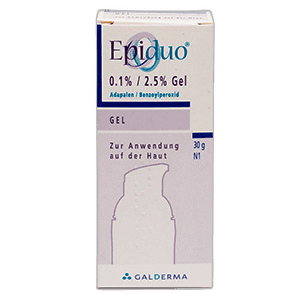
- With adapalene (Epiduo = fixed combination)
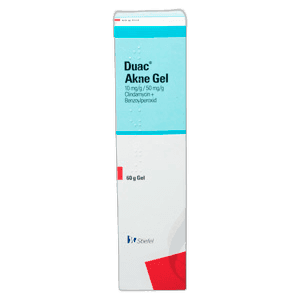
- With topical antibiotics (Duac = fixed combination)
- With retinoids at different times (BPO in the morning, retinoid in the evening)
Stability problem: Tretinoin is inactivated by BPO – do not apply at the same time. Adapalene is more stable.
Frequently Asked Questions
10% is intended for severe acne and for acne in which a lower-concentration preparation has not led to treatment success. Higher concentrations dry out and irritate more. 2.5% is ideal for most people.
BPO releases oxygen, which acts like bleach. Use white or old fabrics and let the product absorb well before going to bed.
Yes, but at different times: BPO in the morning, retinoid in the evening. Or use a fixed combination such as Epiduo. Do not apply at the same time, as BPO can inactivate tretinoin.
Bacteria cannot develop resistance to BPO (oxidative mechanism). If you use an antibiotic for acne, BPO should always be added to prevent the development of resistance.
Similar Medications
Is Benzoyl peroxide right for you?
A licensed doctor will review your information and issue a prescription if suitable. Discreet and secure.
Important Notice
This information does not replace medical advice. If you have questions about your health or the suitability of this medication, please consult a doctor or pharmacist.
Important Safety Information
This service operates under German pharmaceutical law (HWG). For risks and side effects, read the package leaflet and consult your doctor or pharmacist. All medications are dispensed from a licensed pharmacy in Germany.