
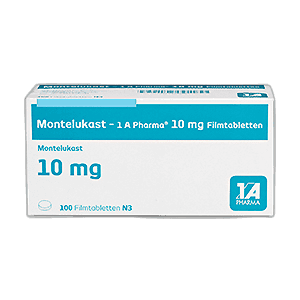
What is Montelukast?
Montelukast is a leukotriene receptor antagonist (LTRA) that is taken as a tablet and used for the long-term treatment of asthma and allergic rhinitis. Unlike inhalers, montelukast is swallowed and acts systemically.
Leukotrienes are inflammatory messengers that play an important role in asthma. Montelukast blocks their action, thereby reducing inflammation, mucus production and bronchospasm.
Well-known brand names include Singulair®, Montelukast dura® and numerous generics. It is approved for adults and children aged 6 months and older.
Active Ingredients & Mechanism of Action
Active ingredient: Montelukast
Montelukast blocks the cysteinyl leukotriene receptors:
Mechanism of action: 1. Leukotrienes (LTC4, LTD4, LTE4) are released during allergic reactions 2. They cause bronchoconstriction, mucus production and inflammation 3. Montelukast competitively blocks the CysLT1 receptor 4. The action of the leukotrienes is canceled out
Effects:
- Bronchodilation (within hours)
- Anti-inflammatory action in the airways
- Reduced mucus production
- Reduction of eosinophils in the airways
Time course:
- Onset of action: within a few hours
- Full effect: after a few days of regular use
- Duration of action: 24 hours (once-daily dosing)
Who is it suitable for?
Montelukast is suitable for:
- Add-on therapy for asthma (to ICS)
- Exercise-induced asthma
- Allergic asthma with concurrent allergic rhinitis
- Children aged 6 months and older
- Patients who cannot use inhalers correctly
Areas of use:
- Mild persistent asthma (alternative to low-dose ICS)
- Moderate asthma as an add-on to ICS
- Prevention of exercise-induced asthma
Not suitable as:
- Sole therapy for moderate to severe asthma
- Acute treatment of asthma attacks
- A replacement for inhaled corticosteroids in most patients
Available Dosages
Adults and adolescents aged 15 years and older:
- 10 mg film-coated tablet once daily in the evening
Children 6-14 years:
- 5 mg chewable tablet once daily in the evening
Children 2-5 years:
- 4 mg chewable tablet or granules once daily in the evening
Children 6 months to 2 years:
- 4 mg granules once daily in the evening
- Persistent asthma must be diagnosed by a pediatrician or pulmonologist
Note: Always take in the evening, as leukotriene production is highest at night.
Dosage form and pack sizes
The medicines catalogue lists one pack variant: one strength in one pack size.
- Dosage form
- Filmtablette
- Strengths
- 10 mg
- Pack sizes
- 20 units
| Strength | Pack | PZN | Duration |
|---|---|---|---|
| 10 mg | 20 units | 09326298 | 20 days |
Packs listed in the German medicines catalogue. Which of them are currently available and what they cost is shown in the price overview.
The Pharmazentralnummer (PZN) is the nationwide unique identifier of a pack in Germany.
Duration is the catalogue value for the usual dosage. How long a pack actually lasts depends on the dose your doctor prescribes.
How to Take
How to take:
- Once daily in the evening, with or without food
- Swallow film-coated tablets with water
- Chew chewable tablets before swallowing them
- Place granules directly on the tongue or mix them into soft food
Important notes:
- Keep taking it even when you have no symptoms
- If neuropsychiatric symptoms occur, stop taking it and inform your doctor
- Not a substitute for a rescue inhaler
- If you forget a dose: take the next dose at the usual time
Contraindications
Do not use in case of:
- Hypersensitivity to montelukast or any of the ingredients
Use with caution in case of:
- Phenylketonuria (chewable tablets contain aspartame)
- Pre-existing psychiatric conditions
- Liver insufficiency (dose adjustment usually not necessary)
Pregnancy: Limited data. Use only if clearly indicated. Inhaled corticosteroids have been better studied in pregnancy.
Breastfeeding: Passes into breast milk. Weigh benefits against risks.
Possible Side Effects
Common (1-10%):
- Headache
- Abdominal pain
- Diarrhea
- Nausea
- Skin rash
Uncommon:
- Dizziness
- Dry mouth
- Fatigue
Uncommon but important (neuropsychiatric effects):
- Sleep disturbances, nightmares
- Restlessness, agitation
- Depressed mood
- Behavioral changes in children
- Suicidal thoughts (very rare, but FDA warning)
Important: If mood changes, sleep disturbances or abnormal behavior occur, inform your doctor immediately!
Interactions
Interactions:
- CYP3A4 and CYP2C9 inducers (phenobarbital, rifampicin) – may lower montelukast levels
- Gemfibrozil – may raise montelukast levels
No relevant interaction with:
- Inhaled corticosteroids (useful combination)
- Beta-2 agonists
- Antihistamines
- Oral contraceptives
Note: Overall, montelukast has a favorable interaction profile.
Frequently Asked Questions
No, montelukast is not a type of cortisone. It is a leukotriene receptor antagonist and works through a different mechanism than corticosteroids. It specifically inhibits the action of leukotrienes.
Usually not. In most patients, montelukast is less effective than inhaled corticosteroids. It is mostly used as an add-on. Only in mild asthma can it be considered as an alternative.
Leukotriene production is highest at night. Taking it in the evening means the drug level is highest during the critical nighttime phase, which provides better control of nighttime asthma symptoms.
Occasionally, sleep disturbances, nightmares, restlessness or mood changes may occur. Behavioral changes are sometimes observed in children. If such symptoms occur, the medication should be stopped and the doctor informed.
Similar Medications
Is Montelukast right for you?
A licensed doctor will review your information and issue a prescription if suitable. Discreet and secure.
Important Notice
This information does not replace medical advice. If you have questions about your health or the suitability of this medication, please consult a doctor or pharmacist.
Important Safety Information
This service operates under German pharmaceutical law (HWG). For risks and side effects, read the package leaflet and consult your doctor or pharmacist. All medications are dispensed from a licensed pharmacy in Germany.