
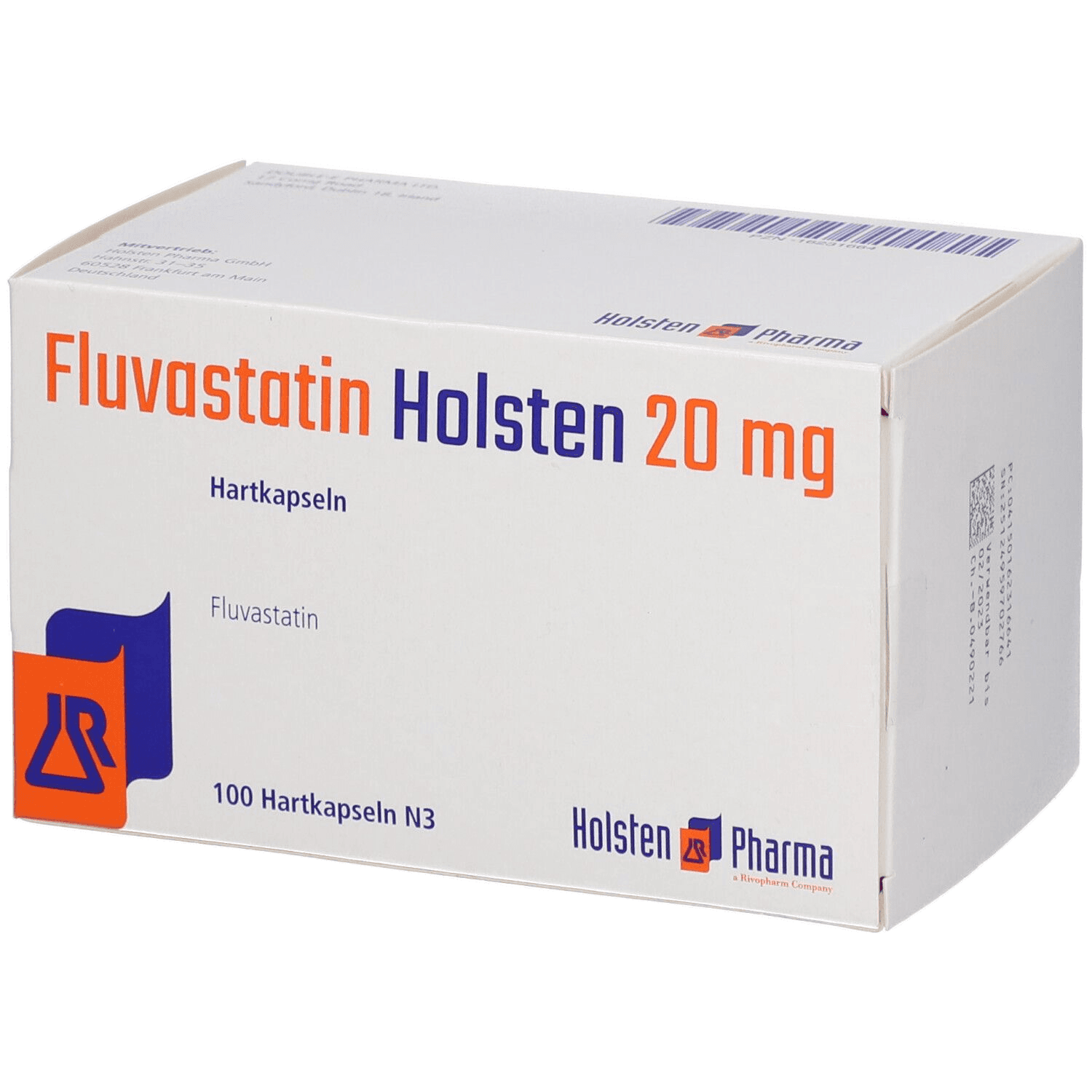
What is Fluvastatin?
Fluvastatin is a synthetic statin that is broken down via several metabolic pathways and only to a small extent via CYP3A4. It is used to treat hypercholesterolemia and for secondary prevention after coronary angioplasty (cardiac catheterization procedure).
Fluvastatin was known under the brand name Locol® (as an extended-release tablet: Locol® XL) and is now available as a generic (e.g., Fluvastatin-ratiopharm®). The LIPS study (Lescol Intervention Prevention Study) showed a particular benefit after percutaneous coronary intervention (PCI).
It is one of the less potent statins and is used mainly for mild to moderate cholesterol elevation or as a statin with a favorable interaction profile.
Active Ingredients & Mechanism of Action
Active ingredient: Fluvastatin (als Natriumsalz)
Fluvastatin inhibits cholesterol biosynthesis:
Mechanism of action:
- Inhibits HMG-CoA reductase
- Fully synthetic statin (indole derivative)
- Reduces hepatic cholesterol production
- Compensatory upregulation of LDL receptors
Lipid-lowering effect:
- LDL cholesterol: reduction of 20–35% (dose-dependent)
- Triglycerides: reduction of 10–15%
- HDL cholesterol: increase of 3–8%
Special features:
- Metabolized via CYP2C9 (not CYP3A4!) → different interactions than simvastatin/atorvastatin
- High selectivity for liver cells
- Rapid uptake into the liver (high first-pass effect)
- Extended-release form (XL) enables constant drug levels
Onset of action: LDL reduction measurable after 1–2 weeks. Maximum effect after 4 weeks.
Who is it suitable for?
Fluvastatin is suitable for:
- Adults with hypercholesterolemia
- Secondary prevention after coronary angioplasty (PTCA/PCI)
- Mixed dyslipidemia
- Patients who have to take CYP3A4 inhibitors
Particularly recommended for:
- After a cardiac catheterization procedure (LIPS study)
- When other statins are not possible due to CYP3A4 interactions
- Mild to moderate cholesterol elevation
Not suitable:
- Pregnancy and breastfeeding
- Active liver disease
- When a strong LDL reduction (> 35%) is required
Available Dosages
Capsules:
- 20–40 mg once daily in the evening
Extended-release tablets (XL):
- 80 mg once daily (can be taken at any time of day)
Available strengths:
- 20 mg, 40 mg capsules
- 80 mg extended-release tablets (XL)
LDL reduction by dose:
- 20 mg: approx. 20–25%
- 40 mg: approx. 25–30%
- 80 mg (XL): approx. 33–35%
Dose adjustment:
- Mild to moderate renal impairment: no adjustment needed
- Hepatic impairment: contraindicated in active disease
Dosage form and pack sizes
The medicines catalogue lists 2 pack variants: 2 strengths in one pack size.
- Dosage form
- Hartkapsel
- Strengths
- 20 mg, 40 mg
- Pack sizes
- 100 units
| Strength | Pack | PZN | Duration |
|---|---|---|---|
| 20 mg | 100 units | 16231664 | 100 days |
| 40 mg | 100 units | 16231693 | 100 days |
Packs listed in the German medicines catalogue. Which of them are currently available and what they cost is shown in the price overview.
The Pharmazentralnummer (PZN) is the nationwide unique identifier of a pack in Germany.
Duration is the catalogue value for the usual dosage. How long a pack actually lasts depends on the dose your doctor prescribes.
How to Take
Capsules (20/40 mg):
- Take once daily in the evening (short half-life)
- Regardless of meals
- Swallow the capsule whole with water
Extended-release tablets (80 mg XL):
- Once daily, at any time of day
- Do not split, chew, or crush the tablet
- Regardless of meals
Important information:
- Laboratory check after 4–12 weeks (liver function tests, lipids)
- Report muscle pain to your doctor
- No problem with grapefruit juice (not a CYP3A4 substrate)
If you miss a dose: Take it at the next regular time. Do not take a double dose.
Contraindications
Fluvastatin must not be taken in cases of:
- Active liver disease or unexplained elevation of transaminases
- Pregnancy and breastfeeding
- Hypersensitivity to fluvastatin
Caution in cases of:
- Renal impairment
- Hypothyroidism
- History of muscle disorders
- High alcohol consumption
- Concomitant use of fibrates
- CYP2C9 inhibitors (fluconazole)
Pregnancy: Contraindicated. Reliable contraception required.
Possible Side Effects
Common (1–10%):
- Sleep disturbances
- Headache
- Gastrointestinal complaints (dyspepsia, abdominal pain, nausea)
- Muscle pain
- Elevated liver enzymes
Uncommon (0.1–1%):
- Fatigue
- Dizziness
- Skin rash
- Paresthesia
Rare:
- Myopathy, rhabdomyolysis
- Hepatitis
- Vasculitis
- Hypersensitivity reactions
General: Fluvastatin is considered a well-tolerated statin. The rate of myopathy is comparable to that of other statins at therapeutic doses.
Interactions
Metabolism via CYP2C9 (not CYP3A4!): This means different interactions than with simvastatin or atorvastatin.
Caution with:
- Fluconazole (CYP2C9 inhibitor → increased fluvastatin levels)
- Fibrates (gemfibrozil) → risk of myopathy
- Phenytoin → mutual changes in levels
- Warfarin → INR monitoring (fluvastatin mildly inhibits CYP2C9)
- Cyclosporine → increased levels of both substances
- Colchicine → risk of myopathy
No relevant interaction with:
- Grapefruit juice (not a CYP3A4 substrate)
- Erythromycin, clarithromycin
- Itraconazole, ketoconazole
- Verapamil, diltiazem, amiodarone
Advantage: Most CYP3A4-dependent interactions that are problematic with simvastatin and atorvastatin do not apply to fluvastatin.
Frequently Asked Questions
The LIPS study showed that fluvastatin significantly reduces the rate of major cardiac events after coronary angioplasty (cardiac catheterization with balloon dilation). It helps prevent renewed narrowing (restenosis).
The 80 mg extended-release tablet has the advantage that it can be taken at any time of day (not only in the evening). It provides constant drug levels. For patients who want flexibility in when they take it, it is the better choice.
Fluvastatin is broken down via CYP2C9, not via CYP3A4. Since most problematic statin interactions occur via CYP3A4 (macrolide antibiotics, antifungals, HIV medications), these are not a problem with fluvastatin.
Similar Medications
Is Fluvastatin right for you?
A licensed doctor will review your information and issue a prescription if suitable. Discreet and secure.
Important Notice
This information does not replace medical advice. If you have questions about your health or the suitability of this medication, please consult a doctor or pharmacist.
Important Safety Information
This service operates under German pharmaceutical law (HWG). For risks and side effects, read the package leaflet and consult your doctor or pharmacist. All medications are dispensed from a licensed pharmacy in Germany.