
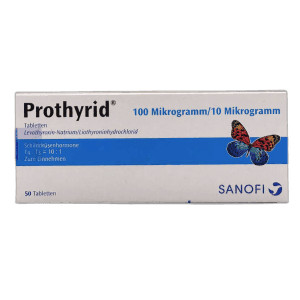
What is Prothyrid?
Prothyrid is a combination product containing levothyroxine (T4) and liothyronine (T3) for the treatment of an underactive thyroid. It contains the two thyroid hormones in a specific ratio and is used when T4 therapy alone is not sufficient.
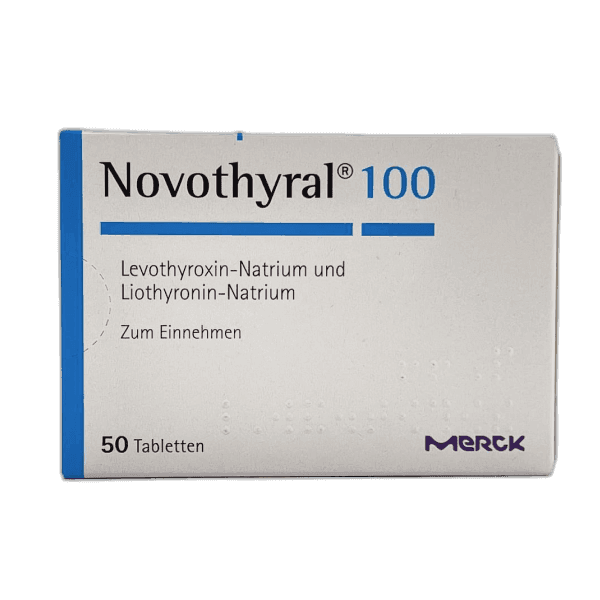
Like Novothyral, Prothyrid is intended for patients who continue to experience symptoms of an underactive thyroid despite normal TSH levels on L-thyroxine monotherapy. The ratio of T4 to T3 differs from that of Novothyral, which allows for more finely tuned dosing.
It is prescribed on an individual basis by the treating endocrinologist or internist.
Active Ingredients & Mechanism of Action
Active ingredient: Levothyroxin (T4) / Liothyronin (T3)
The product contains two thyroid hormones.
Levothyroxine (T4) is the synthetically produced form of the hormone that the thyroid gland mainly produces. It acts as a storage form: the body converts it into active T3 as needed. This results in a steady level.
Liothyronine (T3) is already the active form. It acts faster, but also for a shorter time.
The combination is approved for the treatment of an underactive thyroid. In practice, it is mainly considered when symptoms persist on levothyroxine alone even though blood test results are normal. Whether this applies in an individual case is decided by the medical review based on the blood test results.
Because the T3 component has a faster onset, the body reacts more sensitively to dose changes than with a pure T4 product. Even small deviations can trigger palpitations, restlessness, or sleep disturbances.
Who is it suitable for?
Prothyrid may be suitable for:
- Patients with hypothyroidism and an inadequate response to L-thyroxine
- Cases of proven or suspected impaired T4-to-T3 conversion
- Following medical consideration, as an alternative to Novothyral
Standard therapy remains L-thyroxine alone.
Particular caution is required in:
- Coronary heart disease
- Heart rhythm disorders
- Postmenopausal women with an increased risk of osteoporosis
- Older patients with cardiovascular risk factors
Available Dosages
Available strength:
- 100 mcg levothyroxine + 10 mcg liothyronine per tablet
Dosage:
- Individualized based on lab results (TSH, fT3, fT4)
- Usually 1 tablet daily
- Close monitoring when changing therapy
Dosage form and pack sizes
The medicines catalogue lists one pack variant: one strength in one pack size.
- Dosage form
- Tablette
- Strengths
- 100/10 µg
- Pack sizes
- 100 units
| Strength | Pack | PZN | Duration |
|---|---|---|---|
| 100/10 µg | 100 units | 02532942 | 100 days |
Packs listed in the German medicines catalogue. Which of them are currently available and what they cost is shown in the price overview.
The Pharmazentralnummer (PZN) is the nationwide unique identifier of a pack in Germany.
Duration is the catalogue value for the usual dosage. How long a pack actually lasts depends on the dose your doctor prescribes.
How to Take
- Once daily in the morning, on an empty stomach, at least half an hour before breakfast, with a little water.
- The time gap before the meal is important: food, especially coffee, milk, and soy products, reduces absorption.
- The dose is determined by the doctor and increased slowly — with particular caution in older people and in people with heart disease.
- Do not increase or stop it on your own. Even if nothing seems to change: the effect builds up over weeks.
Intervals from other medicines
- At least two hours apart from products containing calcium, magnesium, or iron, and from heartburn medicines.
- At least four to five hours apart from colestyramine and similar products.
Missed dose: If you notice on the same morning, the tablet can still be taken. Otherwise, continue as normal the next day — do not take a double dose.
Monitoring: After every dose change and after switching products, blood levels should be checked, usually after six to eight weeks.
Contraindications
Do not use in cases of:
- Hypersensitivity to any of the ingredients.
- Untreated overactive thyroid.
- Untreated adrenocortical insufficiency.
- Untreated dysfunction of the pituitary gland with adrenal involvement.
- Recent heart attack, acute inflammation of the heart muscle, acute inflammation of all layers of the heart wall.
To be clarified with a doctor before use: Coronary heart disease, heart failure, heart rhythm disorders, high blood pressure, long-standing underactive thyroid, older age, and a severely underactive thyroid. In these cases, the dose is adjusted particularly slowly.
Not for weight loss. Thyroid hormones are not suitable for this purpose; in people with normal thyroid function, higher doses can cause serious, even life-threatening side effects.
Possible Side Effects
When the dose is correctly adjusted, side effects are rare. If they do occur, they are usually signs of a dose that is too high — the body then reacts as it would to an overactive thyroid:
- Palpitations, fast or irregular pulse
- Inner restlessness, nervousness, tremor
- Sleep disturbances
- Increased sweating, sensitivity to heat
- Weight loss despite unchanged eating habits
- Diarrhea
- Headache, muscle weakness, muscle cramps
- In women: menstrual cycle disorders
Such signs should be checked by a doctor; an adjustment of the dose is usually sufficient.
Rare: Hypersensitivity reactions of the skin. With longer use of higher doses, bone density may decrease.
Have it checked by a doctor immediately in case of: persistent racing heart, heart rhythm disorders, chest pain, or shortness of breath.
Interactions
The effect may be reduced by:
- Products containing calcium, magnesium, or iron, as well as heartburn medicines (keep the interval)
- Colestyramine, colestipol, sevelamer
- Certain antiepileptic medicines (carbamazepine, phenytoin), rifampicin
- Soy-containing foods and dietary supplements
The effect of other medicines may change:
- Coumarin-type blood thinners: The tendency to bleed may increase; clotting values should be monitored.
- Blood sugar-lowering medicines and insulin: Requirements may change; blood sugar should be monitored more closely.
- Cardiac glycosides: Their effect may decrease.
Other: Amiodarone, iodine-containing contrast agents, and lithium affect thyroid function. Estrogen-containing products may increase the requirement.
Please list all medicines you take, including non-prescription ones.
Frequently Asked Questions
Both contain T4 and T3. The difference lies in the T3 content: Prothyrid contains 10 mcg T3 per 100 mcg T4, Novothyral 20 mcg T3 per 100 mcg T4. Prothyrid therefore has a lower T3 content.
The evidence on whether the T4/T3 combination is superior to T4 alone is not clear-cut. Medical societies continue to recommend L-thyroxine as the standard therapy. However, adding T3 may be useful in selected patients after careful consideration.
Similar Medications
Is Prothyrid right for you?
A licensed doctor will review your information and issue a prescription if suitable. Discreet and secure.
Important Notice
This information does not replace medical advice. If you have questions about your health or the suitability of this medication, please consult a doctor or pharmacist.
Important Safety Information
This service operates under German pharmaceutical law (HWG). For risks and side effects, read the package leaflet and consult your doctor or pharmacist. All medications are dispensed from a licensed pharmacy in Germany.